






Chain Restaurant Tables And Chairs: Reducing The Kit Of Parts To Control Cost
Quick Answer: How Many Table and Chair SKUs Does a Chain Need?
Most chains can furnish every site format from 12–18 SKUs: three chair types, two table top sizes, two top substrates, three bases, one booth module and one bar stool. The reduction comes from modularity — one top that works on three bases across four layouts — rather than from buying fewer things. Cutting SKU count by half typically removes 8–15% of landed cost through order consolidation, lower safety stock and fewer spare part lines, and it usually improves the estate's visual consistency at the same time.
For specification questions beyond the scope of this article, see the CDG FAQ library.
The pressure behind that arithmetic is opening rate. A brand opening 30–50 sites a year cannot afford 40 SKUs, because each one carries a sample, a colour chip, a minimum order quantity and a spare-parts line. At an MOQ of 50–100 pieces per SKU, a fragmented range locks capital into slow-moving variants while the models that actually appear in every site wait for production slots.
SKU count is a working-capital decision
Every SKU carries three costs that never appear on a quotation: the sample and approval cycle, the minimum order quantity that must be held or written off, and the spare parts that must exist for eight years. A 40-SKU range at 50 pieces MOQ is 2,000 pieces of committed inventory before a single site opens, spread across models that may never be reordered.
| Family | SKUs | Variants | Covers |
|---|---|---|---|
| Dining chair | 3 | Side chair, armchair, stackable side chair | Urban, suburban, flagship |
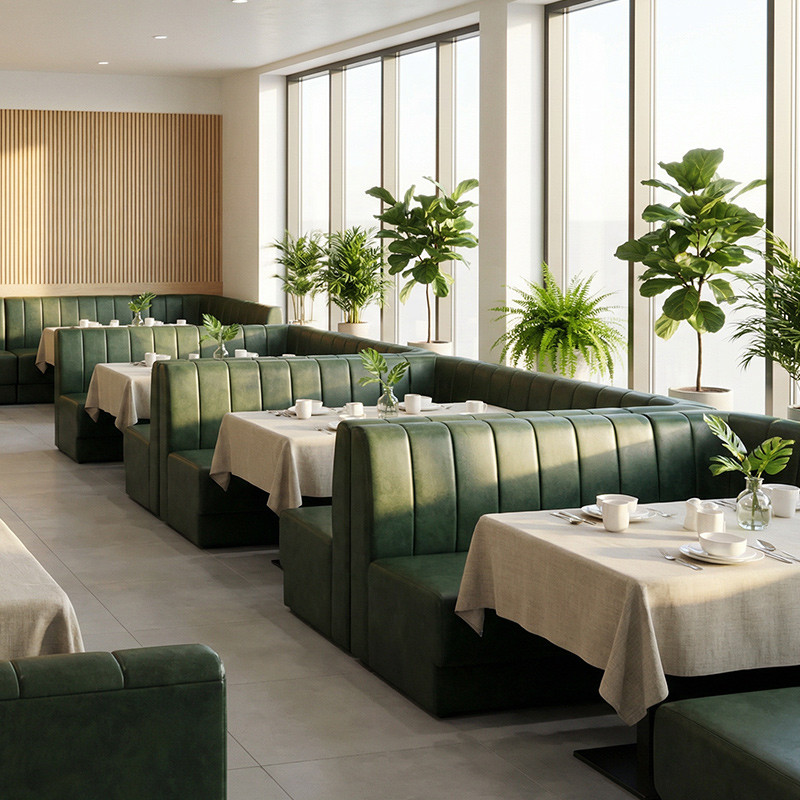
| Booth module | 2 | Two-seat bench, corner bench | Suburban, flagship, mall |
| Bar stool | 2 | Low-back, backless | Urban, food court |
| Table top | 3 | 700 sq, 1,200 × 700, 1,800 × 800 communal | All formats |
| Top substrate | 2 | HPL 13 mm, compact laminate 12 mm | Dry zones, wet zones |
| Table base | 3 | Single pedestal, twin pedestal, four-leg | All table sizes |
| Total | 15 | — | Five site formats |
Table 1. A 15-SKU kit of parts that covers five site formats.
Three checks worth taking from this guide
Why SKU Count Drives Chain Furniture Cost
Cost in a chain programme is a function of concentration, not of unit price. The same chair at 200 pieces and at 2,000 pieces is not the same product commercially: the larger order buys a dedicated production slot, a single dye lot for the powder coat and a container plan that fills cleanly. Fragmentation reverses all three, and the losses appear as colour variation, part shipments and freight waste rather than as a visible price increase.
There is an operational cost too. Store managers who must order a replacement from a 40-line catalogue order the wrong variant roughly one time in five, in our experience, and a wrong variant is a chair that does not match the row it sits in. A 15-line kit with photographs and site-format mapping removes most of that error.
Building a 15-SKU Kit of Parts
Direct Answer: Build the kit from the layout, not from the catalogue. Take the four or five layouts the brand actually uses, overlay them, and specify the smallest set of tables and chairs that can build all of them. The overlap is the kit; everything outside the overlap is a variant the brand does not need.
Chairs, tables, tops, bases and booth modules
Start with chairs, because they carry the most variants and the most emotion. Three types cover almost every chain: a side chair for tables, an armchair for family and lounge zones, and a stackable side chair for overflow and closing routines. Then fix two top sizes and a communal top, three bases that between them carry every top, and one booth module in two configurations. That is the entire kit, and it furnishes every format from 60 to 200 seats.
Then write the compatibility matrix. A single pedestal carries 700 mm and 900 mm round tops comfortably; a twin pedestal carries 1,200 × 700 mm and 1,800 × 800 mm; four-leg frames suit rectangular tops in tight footprints. The matrix prevents the most expensive kit-of-parts error, which is a base specified for a top it cannot stabilise.
| Top size | Single pedestal | Twin pedestal | Four-leg | Seat count |
|---|---|---|---|---|
| 700 × 700 mm | Yes | Not needed | Yes | 2 |
| 900 mm round | Yes | No | No | 2–4 |
| 1,200 × 700 mm | Marginal — check overhang | Yes | Yes | 4 |
| 1,800 × 800 mm | No | Yes | Marginal | 6 |
| 2,400 × 800 mm | No | Yes with cross brace | No | 8 |
Table 2. Top-to-base compatibility matrix.
Modularity: One Top, Three Bases, Four Layouts
Modularity is what lets 15 SKUs behave like 40. One 1,200 × 700 mm top on a twin pedestal makes a four-seat dining table; the same top on a four-leg frame makes a window table; two of them pushed together make an eight-seat communal run; one of them against a booth makes a mixed module. The customer sees four layouts, the factory sees one top.
The constraint is consistency of height and edge. If one base runs at 750 mm and another at 745 mm, adjacent tables in a run will not align and the modularity is cosmetic. Specify 750 mm ±2 mm across all bases in the kit, and specify one edge profile for every top so that pushed-together tables read as one surface.
Common Parts and Spare Strategy
Common parts are the hidden saving in a reduced kit. If all three chairs share one glide, one seat pad size and one bolt pack, the spare inventory collapses from nine lines to three. Brands that specify a common glide across the kit can hold a single spare bin per region and solve 80% of damage reports from it.
Set the spare ratio at 2–3% of order value and hold it centrally rather than per site. Sites that hold their own spares over-order and still run out, because the parts that fail are not the parts they predicted. A central pool with a two-day dispatch commitment is cheaper and faster in practice.
The Cost Effect of SKU Reduction
The saving appears in four places: better unit price at concentrated volume, fewer part shipments, lower safety stock and less freight waste from part-filled containers. In programme terms, halving the SKU count typically recovers 8–15% of landed cost, and most of it comes from the last two items rather than from the unit price, which is why buyers who negotiate only on unit price miss it.
There is a revenue effect as well. A consistent estate photographs better, and consistency is what lets a brand run one campaign image across 50 sites. That is hard to put in a spreadsheet, but it is the reason design teams defend standards even when procurement would prefer more local choice.
Testing the Kit Against Five Site Formats
Before releasing the kit, build each site format on paper from the kit alone. If a layout needs a SKU that is not in the kit, either the layout is wrong or the kit is incomplete, and that decision is much cheaper to take on paper than after 20 sites have been furnished. The test takes a day and usually removes two unnecessary variants.
Then test the kit against the actual floor plans of the next five openings, including the awkward ones: a listed building with a narrow door, a mall unit with landlord linking rules, a coastal site needing higher coating. Those three constraints are what expose a kit that looked modular in a showroom but is rigid in the field.
For matching specifications, lead times and warranty terms, see the indoor restaurant tables, indoor restaurant chairs and commercial table tops pages; each is specified against the same duty cycles and test standards used above.
Let's Rationalise Your Furniture Range
Send your current SKU list and the floor plans for the next five openings. We will return a consolidated kit of parts with a compatibility matrix, a spare-parts plan and a landed-cost comparison between the current range and the reduced one. If the range is already lean, we will show where the remaining variants can be merged without changing the layout.
Contact: lisaliang@cdgfurn.com | +86 139 2610 3331 (WhatsApp / WeChat) | Export office +86 20 3693 3270 | Inquiry form and contact page on cdgfurn.com.
Continue with the inquiry form, the contact page, the restaurant furniture catalog and the CDG Blog.
Answer-First Reference: Kit of Parts Numbers
chain restaurant tables and chairs is specified against measured duty cycles, documented material performance and a repeatable after-sales programme. The figures in this guide are working ranges used in pre-order reviews; confirm every threshold against the project brief and the purchase order before a deposit is paid.
What is a reasonable SKU count for a restaurant chain?
Twelve to eighteen across the whole estate, and eight or fewer per site format. Above about 25, the sample and spare-part overhead starts to exceed the flexibility gained, and stores begin ordering the wrong variant. Below about 10, the layout usually starts to repeat itself in ways customers notice.
Can one table top serve several layouts?
Yes, if height tolerance and edge profile are held constant. A 1,200 × 700 mm top on a twin pedestal makes a four-seat dining table, the same top on a four-leg base makes a window table, and two together make an eight-seat run. The requirement is 750 mm ±2 mm across all bases and one edge profile across all tops.
How many spares should a chain hold?
Two to three percent of order value, held centrally with a two-day dispatch commitment. Central holding beats per-site holding because sites over-order the parts they expect to fail and run out of the parts that actually fail. Common glides and one bolt pack across the kit make the central pool small enough to be practical.