











Table Top Thickness And Edge Profiles: The Details That Decide Table Life
Quick Answer: Which Edge Profile Should a Restaurant Table Top Have?
Specify a post-formed edge on HPL tops, a machined and polished edge on compact laminate, and a polished or flamed edge on sintered stone, with a minimum 3 mm radius on all vertical edges. Avoid taped or thin banded edges in any zone that is cleaned wet, because water reaches the core through the seam, the core swells and the surface lifts. The edge, not the surface, is what ends a table's life in a restaurant.
For specification questions beyond the scope of this article, see the CDG FAQ library.
Thickness and edge are usually specified together and usually debated as cost items. They are actually life-cycle items: a 13 mm post-formed HPL top in a dry zone typically runs 8–10 years, while the same top with a taped edge in a wet zone often fails in three.
Why the edge is the weakest point
A table top is a panel with a seam around its perimeter. Water, steam and cleaning chemicals concentrate at that seam because that is where a cloth is wrung and where a spill runs off. Any construction that leaves the core exposed at the seam — a taped edge, a thin band with an adhesive line, a machined edge on a moisture-sensitive core — creates a path for water.
| Edge type | Substrate | Water resistance | Repairability | Typical life in wet zone |
|---|---|---|---|---|
| Post-formed | HPL | High — no seam at the core | Low — surface must be replaced | 5–7 years |
| Banded, 2–3 mm | HPL | Medium — adhesive line is the risk | Medium — band can be re-fixed | 3–4 years |
| Taped | HPL or low-grade laminate | Low — seam at the core | Low | 1–3 years |
| Machined and polished | Compact laminate | High — core is sealed | Medium | 10–12 years |
| Polished stone edge | Sintered stone | High | Low — brittle | 12–15 years |
Table 1. Edge constructions compared.
Three checks worth taking from this guide
Thickness: What 12 mm, 13 mm and 18 mm Actually Buy
Direct Answer: Twelve to thirteen millimetres is the commercial working thickness for laminate tops, 12 mm for compact laminate and 6–12 mm for sintered stone. Thicker is not stronger in laminate: an 18 mm top adds weight that stresses the base without adding meaningful resistance to the loads a dining table actually sees.
Thickness buys two things: span capability and edge depth. A 13 mm top can span 700 mm between supports without visible deflection under a normal load; a 25 mm top can span more, which is why solid wood tables often run thick. Edge depth matters because a post-formed edge needs enough thickness to wrap cleanly, and a 6 mm panel produces a tight, fragile edge.
Where thickness genuinely matters is at the joint of a communal run. Two 13 mm tops pushed together at the same height read as one surface; two 18 mm tops with a 2 mm height difference show a step that customers notice and staff cannot fix. Consistency of thickness across a run is worth more than absolute thickness.
Four Edge Constructions and How They Fail
A post-formed edge wraps the decorative surface around a radius, so the top has no visible seam at the perimeter. It fails by chipping at the radius when struck, and by delamination if the bond was poor. A banded edge attaches a strip of the same laminate to the panel edge, and it fails at the adhesive line under moisture. A taped edge uses a thin, often PVC, tape; it fails fastest and is the most common cost-down shortcut in low-grade furniture.
Post-formed, banded, machined and solid edge
A machined edge on compact laminate is simply the core cut and polished, which is why it has no seam to fail. A solid edge — a wood or metal strip — is used for design intent and for tops that will be refurbished rather than replaced, and it is the only edge that can be repaired convincingly on site.
The practical ranking for restaurant use, from most to least durable in a wet zone, is: machined compact, post-formed HPL, solid edge, thick band, thin tape. In a dry zone the top two are effectively equal, which is where the cost saving on a post-formed HPL top is justified.
Radius, Overhang and Drip Details
Three geometric details protect an edge. A minimum 3 mm radius on all vertical edges reduces chipping from chair backs and cleaning trolleys. A 20–30 mm overhang beyond the base plate gives knees room and lets water run off rather than along the underside. A drip groove or a slight under-edge setback at wet zones stops water tracking back under the top.
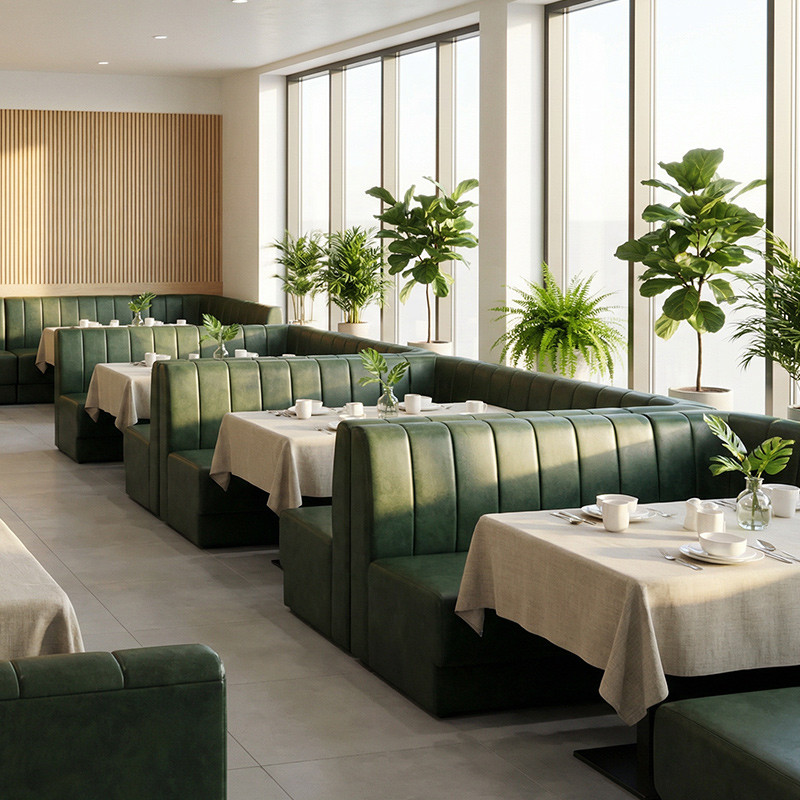
Booth tables need the opposite of a flush edge: a 150–200 mm overhang beyond the bench face is what lets a diner get in and out without moving the table. That overhang is structural, so a booth table with a full-pitch top and no overhang is a table that will be pushed every time someone sits down.
Testing the Edge Before You Order
Two tests take under an hour and catch most weak edges. The water test: pour 50 ml of water along the edge seam, wait two minutes, and check whether the surface under the seam is damp. If it is, water will reach the core in service. The impact test: strike the edge at the radius with a coin or a key at normal hand force and check for chipping or a white stress mark.
Ask for the laminate classification to EN 438 and for the post-forming grade where a wrapped edge is specified. A laminate that is not intended for post-forming will crack at the radius within months, and it is indistinguishable from the correct grade on a sample photograph.
Edge Specification by Zone
Dry indoor dining: 13 mm HPL with a post-formed edge and a 3 mm radius. Wet zones, self-clear stations and heavy cleaning: 12 mm compact laminate with a machined edge. Feature and hot-service tables: 8–12 mm sintered stone with a polished edge and full support beneath. Booth tables: 13 mm HPL with a post-formed edge and a 150–200 mm overhang.
That allocation typically costs 5–10% more than an all-HPL specification and removes the failure mode that accounts for most table replacements in the first three years. It also keeps the visible surfaces consistent, because the substrate change happens in zones customers are less likely to photograph.
Writing Edge Requirements Into the Order
Six fields make the edge specified rather than assumed: substrate and thickness, edge construction, radius, overhang, tolerance on overall dimensions, and the test the edge must pass. Add the laminate grade where post-forming is required, and add a clause that the edge must be inspected at pre-shipment, because edge damage in transit is the most common cause of a rejected top on site.
Packing follows from the same clause. Tops should ship with protective corners and edge foam, stacked no more than a stated height, and marked so they are not used as a shelf for other cartons. A chipped corner in transit is not a transport problem; it is a packing specification problem.
If the layout covers several zones, the indoor restaurant tables, care and maintenance guide and restaurant furniture customization pages give the matching dimensions, substrate options and container quantities for each configuration.
Let's Get the Edge Right
Send the table schedule by zone and the cleaning routine. We will return an edge specification per zone with substrate, thickness, radius and overhang values, the test the edge must pass at inspection, and packing requirements for the container. Edge samples in each construction can be shipped so the difference can be checked with water and a coin rather than argued from a brochure.
Contact: lisaliang@cdgfurn.com | +86 139 2610 3331 (WhatsApp / WeChat) | Export office +86 20 3693 3270 | Inquiry form and contact page on cdgfurn.com.
Continue with the inquiry form, the contact page, the restaurant furniture catalog and the CDG Blog.
Answer-First Reference: Edge and Thickness Numbers
table top edge profiles is specified against measured duty cycles, documented material performance and a repeatable after-sales programme. The figures in this guide are working ranges used in pre-order reviews; confirm every threshold against the project brief and the purchase order before a deposit is paid.
Is a post-formed edge better than a banded edge?
Yes, in any zone that is cleaned wet. Post-forming eliminates the seam at the core, which is where water enters. A thick band is acceptable in dry zones and cheaper, but the adhesive line remains the weak point and the top will show it within three to four years of wet cleaning.
What radius should a table top edge have?
Three millimetres minimum, and 5 mm on tables used by children or in tight circulation. A sharp edge chips under chair backs and trolleys, and a chip at the radius is the start of the delamination that ends the top's life.
Does a thicker table top last longer?
Not in laminate. Thirteen millimetres is the commercial working thickness and 18 mm adds weight without meaningful strength. Thickness helps span and edge depth, not abrasion life. What extends life is the edge construction and the substrate's water resistance.