
Outdoor Tables Wholesale The Complete Guide To Commercial Table Materials & Sizes
Every outdoor restaurant, café, and tavern operator eventually faces the same quiet arithmetic: a table that looks right on opening day but fails by the second peak season costs far more than its invoice price. For venues in coastal towns, desert rooftops, rainy beer gardens, and year-round sidewalk cafés, the buying decision is not about style alone. It is about how a commercial outdoor table behaves under sun, salt, spilled drinks, dragged chairs, and the daily rhythm of covers turning from noon until close.
The short answer, for operators who need one: specify a resin table top paired with a powder-coated aluminum or steel frame. That combination delivers the lowest maintenance burden across the widest range of climates, resists fading, rot, and rust, and keeps replacement costs predictable as a patio scales. Resin tops will not crack, chip, or absorb moisture the way wood can, and they clean with soap and water after service. Aluminum bases add lightweight maneuverability for staff resetting floors between shifts, while still holding up to commercial use when the gauge and finish are specified correctly.
That answer holds for most venues, but the right specification changes once seating capacity, footprint, and service style come into play.
Outdoor Restaurant Tables: Sizes, Shapes and Seating Capacity
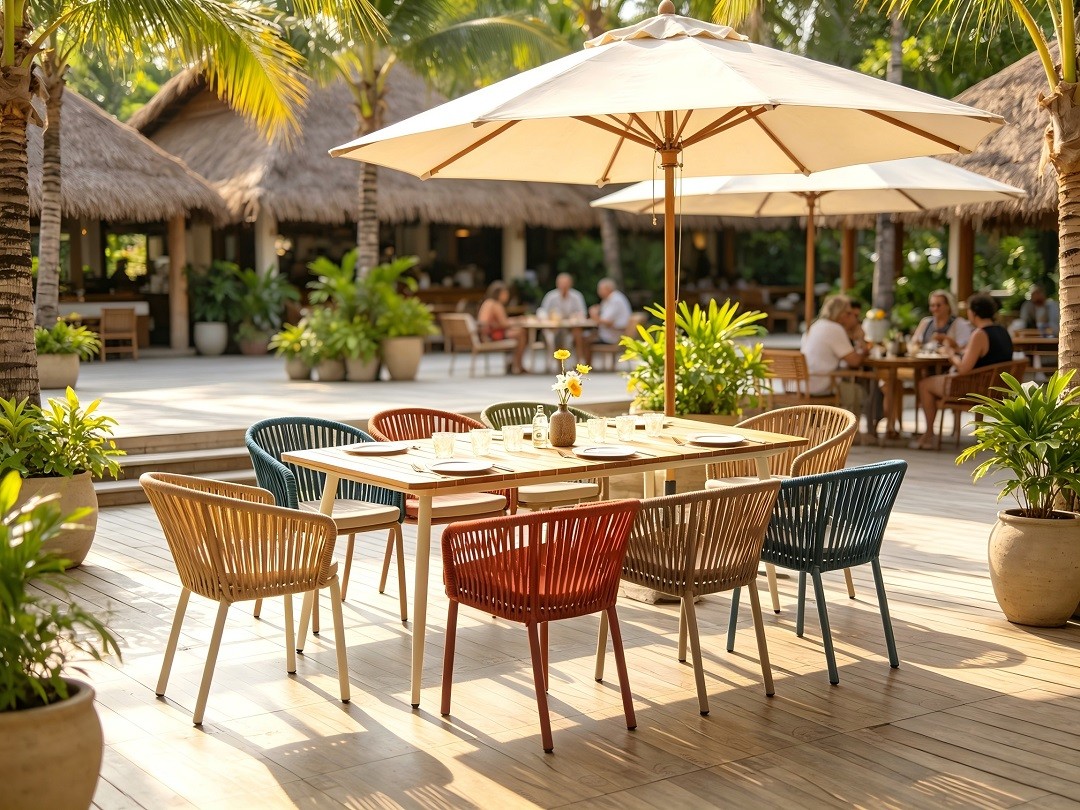
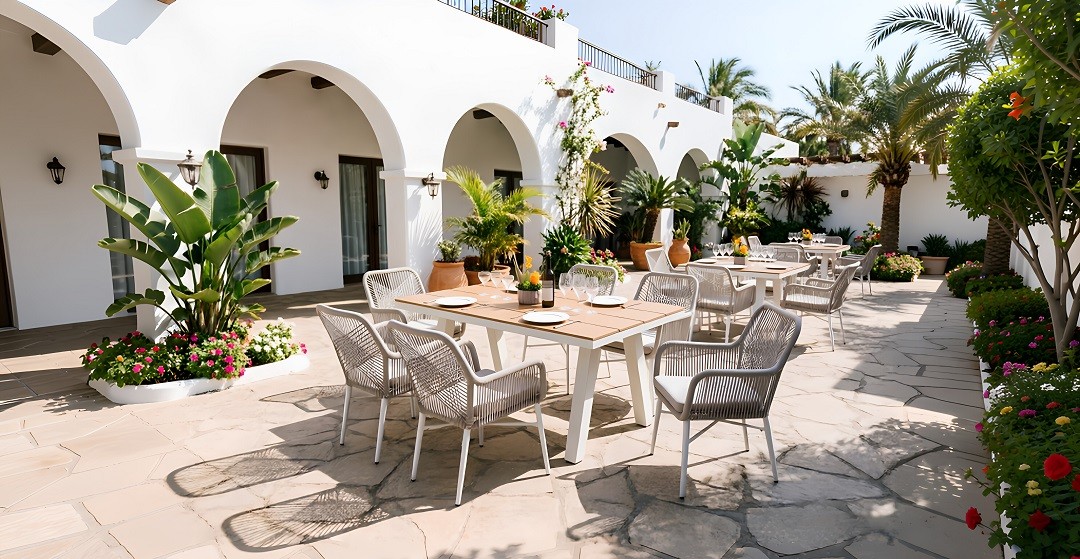
The fastest way to waste money on wholesale outdoor tables is to order by “two-top” and “four-top” language without checking the finished dimensions against the floor plan. Outdoor footprints are tighter than indoor dining rooms, and a table that seats four in a catalogue photo may crowd a narrow sidewalk once chairs are pulled out.
A practical size framework for commercial patio tables looks like this: a 24–30 inch round or square handles two covers comfortably, with enough room for place settings and a small shared plate. For four guests, a 36–42 inch round or a 36 × 48 inch rectangular table is the working range, while six covers call for a 48–60 inch round or a rectangular table in the 60–72 inch length band. Round tables are especially valuable for outdoor cafés and tavern patios because they eliminate the dead corner seat and keep conversation from splitting into two ends. Rectangular and square formats suit wall-adjacent seating and communal beer-garden layouts where table runs need to align.
For operators comparing commercial outdoor tables across a multi-venue group, the sizing question is rarely about one table. It is about whether the same footprint can flex between a quiet afternoon café service and a standing-heavy evening tavern crowd. That is where the table top format and base configuration begin to matter as much as the diameter.
Resin vs Metal vs Wood Outdoor Table Tops
The material decision drives almost every downstream cost: replacement frequency, staff cleaning time, storage weight, and how the patio reads to guests in photographs. Each family of outdoor table top has a place, but they fail for different reasons.
Resin Outdoor Dining Tables: The Low-Maintenance Commercial Choice
Molded resin tops are resistant to scratches, chips, and water damage, including the rotting and molding that shorten the life of wood in damp climates. Unlike metal, resin does not rust in salty coastal air, which is why they are common on seaside patios and hotel terraces. The trade-off is heat sensitivity: hot dishes placed directly on lower-grade resin can mark the surface, so heat resistance should be confirmed in the specification rather than assumed. Commercial-grade resin formulations address this, but the buyer has to ask.
Powder-coated aluminum is the maneuverability play. Aluminum tops are lightweight, rust-resistant, and easy for one staff member to move when a patio needs to be cleared or rearranged between services. A powder-coated finish adds corrosion resistance and a clean, modern look that suits contemporary café and rooftop bar design. The limitation is feel: thin aluminum can sound hollow and may dent under heavy impact if the gauge is light. For high-turnover taverns where tabletops take a beating, a heavier aluminum build or a resin top on an aluminum frame is usually the more resilient pairing.
Wood and wood-look options remain relevant for taverns and garden restaurants that want warmth. Solid wood is beautiful but requires sealing and refinishing to survive year-round outdoor exposure, and it will move with moisture and temperature changes. Synthetic teak and plastic-wood tops offer the wood aesthetic without the rot and splinter risk, and they drain quickly after rain, which matters for uncovered patios. For operators who want the outdoor dining table resin maintenance profile but a more natural visual, a resin top molded to a wood-grain finish is the practical compromise.
A note on thickness and edge construction: commercial outdoor patio table tops are commonly specified in the 10–12 mm range for compact laminate and HPL constructions, with 13 mm, 15 mm, and 18 mm available for heavier-duty applications[reference:0]. Edge profiles—rolled aluminum, anodized aluminum, or sealed composite—matter as much as the surface itself, because exposed edges are where moisture first gets in.
High Top Outdoor Tables and Bar Height Dining for Rooftops
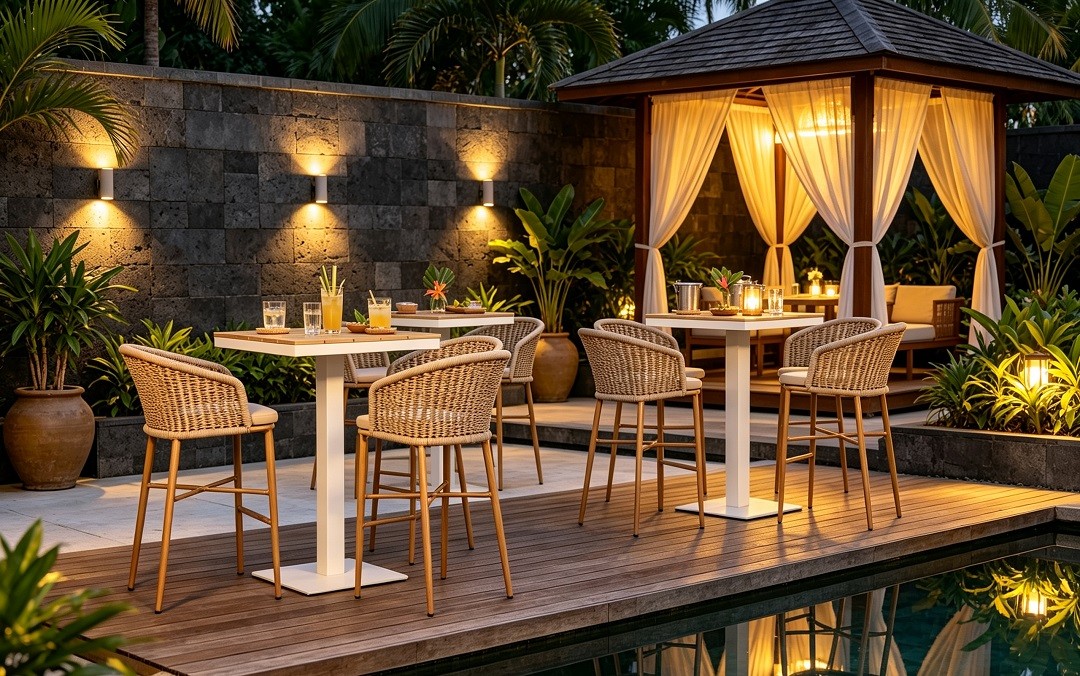
Rooftop bars, taverns with standing rails, and cafés converting pavement space into evening covers are driving steady demand for high top outdoor dining table formats. A finished bar-height top typically sits at 40–42 inches (roughly 1050–1100 mm), paired with stool seats in the 29–31 inch range[reference:1][reference:2]. The classic drink-rail height is 42 inches, while counter-height tables sit lower at 34–37 inches (approximately 900 mm) and belong to a different pairing system entirely.
The specification risk with high tops is stability. Lifting a table top to 42 inches lengthens the lever arm on every lean, bump, and dragged stool, which is why a base that performs adequately at dining height can feel unstable at bar height. Outdoor-rated high tops need bases that drain rather than rust and enough plate weight to resist wind on exposed rooftops. A 24-inch round high top works as a standing perch or a two-person table, while 30–36 inch rounds and squares seat three to four. For taverns mixing seated dining and standing social zones, the base-to-top ratio is the difference between a convivial rail and a spilled-drink machine.
CDG's outdoor table range includes bar-height builds designed for pub-style atmospheres and rooftop service, with base options matched to the exposure level of the site.
Wholesale Outdoor Tables: MOQs, Custom Sizes and Lead Times at CDG
For hospitality groups, distributors, and multi-site operators, the wholesale conversation moves from “which table” to “how many, in what sizes, and on what schedule.” MOQs vary by construction: terrazzo and HPL tops with aluminum edges commonly start around 20–30 pieces per size, with customized dimensions accepted. Lead times for made-to-order tops typically run in the 25–30 day range after deposit, while stocked or simple builds can move faster.
Custom sizing is where a manufacturer relationship earns its keep. A café with a narrow frontage may need a 60 cm depth rather than a standard 70 cm; a tavern with communal benches may want a 180 cm run instead of two smaller tables pushed together. CDG supports customized outdoor tables wholesale programs across resin, plastic-wood, HPL, and aluminum constructions, with table tops and bases quoted as a matched set rather than mismatched components. For buyers sourcing for commercial outdoor dining tables across different markets, specifying top and base together also simplifies freight and reduces the risk of a stable-looking table arriving with an underweight base.
The practical wholesale checklist is short: confirm the finished height, top diameter or length, base weight and material, edge profile, and the finish warranty. A supplier who can answer those five points in writing is easier to scale with than one who quotes only the top.
Outdoor Table Care: Extending the Life of Commercial Patio Tables
Even the right outdoor restaurant tables degrade faster than they should when care routines ignore the material. Resin and HPL tops benefit from routine washing with mild soap and water; abrasive cleaners and scouring pads dull the surface and can compromise the protective finish. Powder-coated aluminum frames should be checked for chips at the welds and touch-up painted before exposed metal begins to oxidize, especially in coastal environments where salt air accelerates corrosion.
Wood-look and plastic-wood tops should be inspected for standing water in slat channels and around umbrella holes, because trapped moisture is what shortens the life of even well-sealed products. Base plates and leveling glides deserve the same attention: a wobbling table is not just a guest annoyance, it is a sign that the base has loosened or the foot has worn, and small corrections prevent larger failures. Venues that stack or move tables between services should specify stackable or lightweight builds deliberately rather than assuming all commercial tables tolerate frequent handling.
Get the CDG Commercial Outdoor Table Specification Pack
Choosing commercial outdoor tables for a restaurant, café, or tavern is a series of small decisions that compound over seasons: the right top material for the climate, the right diameter for the cover count, the right base for the height, and the right wholesale terms for the rollout.
CDG is a commercial outdoor furniture manufacturer supplying hospitality operators, distributors, and project buyers with resin, terrazzo, HPL, plastic-wood, and aluminum table tops and bases. To move from browsing to a quote, send your floor plan or the sizes you are considering. In return, you will receive a Commercial Outdoor Table Specification Pack covering:
- Recommended top material and thickness ranges for your climate and service style
- Size-to-seat-count reference for round, square, and rectangular outdoor tables
- High-top base weight and height pairing guidance for rooftop and tavern applications
- Wholesale MOQ, customization options, and indicative lead times
Share your project details through the Outdoor Tables Wholesale page or request the specification pack directly. A clear brief on covers, footprint, and climate is enough to start the matching process.