
The Complete Guide to Commercial Outdoor Restaurant Furniture: Materials, ROI, and Design Strategies (2026 Edition)
The Global Outdoor Dining Revolution: A $42 Billion Market in 2025
The commercial outdoor furniture market has grown to an estimated $4.2 billion in 2025, projected to reach $7.1 billion by 2034 at a 6.0% CAGR. For restaurant owners, hotel operators, and commercial buyers, outdoor dining spaces have evolved from a seasonal bonus into a strategic revenue driver. Research shows that restaurants with well-designed outdoor seating can increase total seating capacity by 22-30% and boost overall revenue by 15-25% during peak seasons.
CDG Furniture, with over 20 years of experience manufacturing commercial restaurant furniture and exporting to 160+ countries, has witnessed this transformation firsthand. This comprehensive guide draws on our two decades of industry expertise to help you navigate every aspect of commercial outdoor furniture selection—from material science to ROI calculation, from certification standards to 2026 design trends.

1. Understanding Commercial-Grade Materials: The Foundation of Durability
Not all outdoor furniture is created equal. Residential patio sets fail within 1-2 seasons when subjected to commercial use—imagine 12+ hours of continuous seating, frequent cleaning with industrial chemicals, and exposure to sun, rain, and salt air. Commercial-grade outdoor furniture must withstand at least 5-8 years of daily use while maintaining structural integrity and aesthetic appeal.
The global commercial outdoor furniture market breaks down by material type: metal furniture holds 42.5% market share, polymer and composite materials account for 33.8%, and wood/hybrid materials make up 23.7%. Each category serves different operational needs, climates, and aesthetic preferences.
Key Decision Factor: Total Cost of Ownership (TCO)
When evaluating materials, consider TCO over a 5-8 year period—not just the upfront price. A powder-coated aluminum chair that costs $120 but lasts 8+ years with minimal maintenance often delivers lower TCO than a $60 steel chair that rusts and needs replacement every 2-3 years. Factor in: purchase price, maintenance cost, replacement frequency, storage requirements, and cleaning labor. Industry data shows that HDPE and aluminum typically deliver the lowest 10-year TCO, while wood furniture requires the highest ongoing investment—40-60% higher than HDPE alternatives.
2. Aluminum: The Lightweight Champion of Commercial Outdoor Furniture
Powder-coated aluminum dominates the commercial outdoor furniture market for good reason. Its exceptional strength-to-weight ratio, natural corrosion resistance, and versatility in powder-coat finishes make it the preferred choice for high-traffic restaurants, hotels, and cafés worldwide.
Advantages
- 100% rust-proof—ideal for coastal and humid environments
- Lightweight (2.7 g/cm³)—easy to stack, move, and reconfigure
- Powder coating provides UV protection with 3,000+ hours QUV resistance
- Passes ISO 9227 salt spray testing for 500+ hours without pitting
- 100% recyclable—supports ESG and sustainability goals
- Available in 200+ RAL colors for brand matching
- Cast aluminum offers ornate design flexibility
Limitations
- Higher upfront cost than steel (but lower TCO over 5+ years)
- Can be scratched by sharp objects if powder coat is thin
- Very lightweight furniture may shift in strong winds
- Extruded aluminum has less design flexibility than cast
CDG Furniture utilizes 6063-T5 architectural-grade aluminum alloy with electrostatic powder coating, which delivers superior adhesion and corrosion protection. Our aluminum outdoor furniture has been tested in environments ranging from Mediterranean coastal humidity to Middle Eastern desert heat, consistently exceeding EN 581-3 durability standards.
Best Applications
Rooftop restaurants, coastal cafés, hotel pool decks, event venues with frequent reconfiguration needs, and any high-traffic commercial environment where lightweight mobility and rust resistance are priorities.
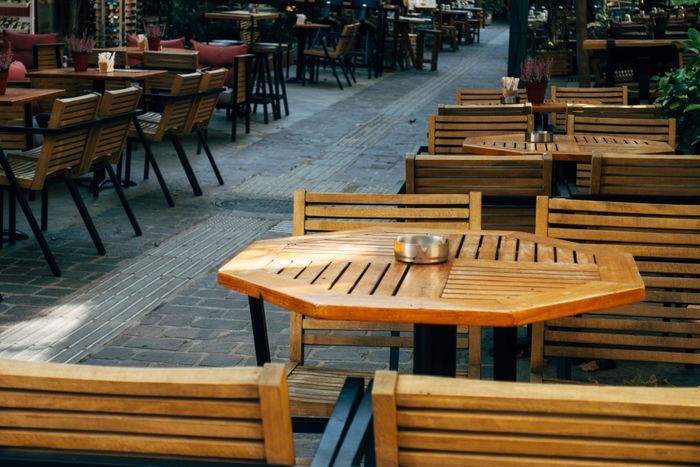
3. Stainless Steel and Wrought Iron: When Strength and Aesthetics Matter Most
Stainless steel and wrought iron represent the premium end of metal outdoor furniture, offering unmatched structural rigidity and distinctive aesthetic profiles. While they require more careful material selection and maintenance planning, they excel in specific commercial applications where weight, stability, and visual impact are paramount.
For luxury hotels, upscale restaurants, and wind-exposed locations, the weight of stainless steel provides inherent stability without needing weights or anchors. CDG Furniture recommends 316 marine-grade stainless steel for any location within 5 miles of saltwater, and 304 grade for inland urban environments. Wrought iron, while offering timeless European bistro aesthetics, requires annual repainting in humid climates and is best suited for covered or semi-enclosed outdoor areas.
4. PE Rattan and Synthetic Wicker: The All-Weather Aesthetic Solution
Polyethylene (PE) rattan has transformed commercial outdoor design, offering the warm, organic look of natural wicker with none of the maintenance headaches. Modern high-density PE rattan is UV-stabilized, colorfast for 5,000+ hours of direct sun exposure, and resistant to mold, mildew, and salt spray—making it the fastest-growing segment in hospitality furniture.
Why PE Rattan Dominates Hospitality Outdoor Design
- Weather Resistance: High-density PE withstands temperatures from -20°C to 80°C without cracking, peeling, or fading. Unlike natural rattan, it never absorbs moisture or develops mold.
- Comfort Factor: The textured surface and natural flex provide comfortable seating without cushions—though quick-dry foam cushions dramatically enhance the guest experience.
- Design Versatility: Available in flat, round, and half-round profiles in 20+ colors, PE rattan adapts to styles from tropical resort to urban industrial.
- Maintenance Simplicity: Hose down with mild soap. No sealing, oiling, or repainting required—ever.
At CDG Furniture, our PE rattan is woven over powder-coated aluminum frames, combining the visual warmth of wicker with the structural integrity of metal. Each woven panel undergoes 24-hour UV chamber testing to verify colorfastness before assembly. Our woven rope and rattan collections have become top sellers in markets from Southeast Asia to Northern Europe, where year-round outdoor dining demands furniture that can handle everything from monsoon humidity to freezing winters.
5. HDPE and Composite Materials: The Sustainable, Zero-Maintenance Future
High-Density Polyethylene (HDPE) lumber is the fastest-growing material category in commercial outdoor furniture, expanding at a 7.2% CAGR through 2034. Made predominantly from recycled post-consumer plastic (milk jugs, detergent bottles), HDPE furniture directly addresses the growing ESG requirements that now influence over 60% of commercial procurement decisions.
Sustainability Benefits
- Made from 90%+ recycled materials (approximately 280 milk jugs per adirondack chair)
- 100% recyclable at end-of-life
- Zero deforestation impact
- Supports LEED certification credits
- No chemical treatments, sealants, or VOCs
- 10-year TCO 40-60% lower than solid wood
Performance Characteristics
- Impervious to moisture, salt, insects, and fungi
- UV-stabilized pigments—color runs through entire board
- No splintering, cracking, or peeling
- Heavy weight provides wind stability
- Withstands -40°C to 60°C
- Density: 0.93-0.97 g/cm³ (comparable to oak)
The primary trade-off is weight and cost. At $200-$400 per chair, HDPE competes with premium aluminum pricing. However, for pool decks, beachfront properties, and eco-conscious brands, the combination of sustainability credentials and zero-maintenance operation delivers a compelling value proposition. CDG Furniture has seen HDPE adoption accelerate among European and North American chain restaurants where ESG reporting has become a board-level priority.
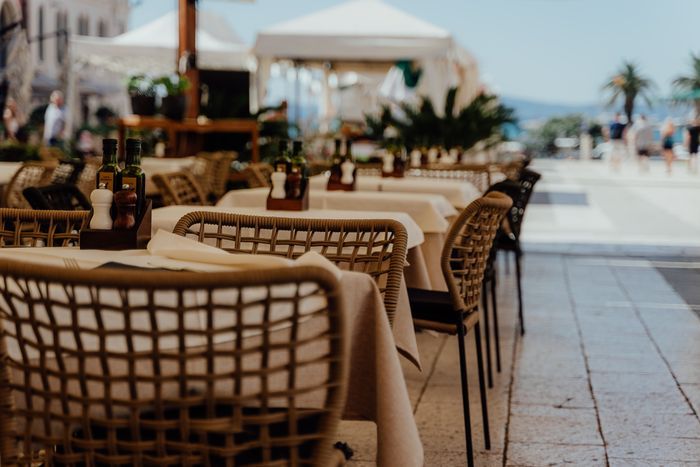
6. Teak and Hardwood: The Premium Choice for Luxury Hospitality
Natural teak remains the gold standard for luxury outdoor furniture, prized for its rich golden-brown color, natural oil content (5-7% by weight), and legendary durability. A well-maintained teak chair can last 25-50 years outdoors—longer than most restaurant leases.
Critical: FSC Certification is Non-Negotiable
CDG Furniture sources exclusively FSC-certified (Forest Stewardship Council) teak from responsibly managed plantations. For commercial buyers, FSC certification is essential for meeting EU Timber Regulation (EUTR) and US Lacey Act requirements, satisfying corporate ESG procurement policies, and aligning with guest expectations—72% of luxury travelers now consider sustainability in their hotel choice.
TCO Reality Check: Teak vs. Alternatives
Premium teak chairs range from $300-$800 per unit. With annual oiling maintenance ($15-25/chair/year) and theft risk in unsecured locations, 10-year TCO can exceed $1,000 per chair. For many commercial buyers, synthetic teak-look alternatives (HDPE lumber or textured aluminum with wood-grain powder coating) now deliver 90% of the aesthetic at 40-60% of the TCO. Genuine teak remains the right choice for 5-star hotels, Michelin-starred restaurants, and luxury resorts where authenticity and prestige justify the premium.
7. Certifications That Matter: EN 581, ISO, BIFMA, and What They Mean
When comparing commercial outdoor furniture suppliers, certifications are your most reliable quality filter. These standards verify that furniture has been independently tested for safety, durability, and performance under conditions far more demanding than typical use.
EN 581 (European Standard)
Part 1: Safety requirements for outdoor furniture.
Part 2: Mechanical safety (static load: 1,600N seat, 800N backrest).
Part 3: Outdoor durability testing (UV, humidity, temperature cycling).
ISO 9227 (Salt Spray)
Tests corrosion resistance through continuous salt fog exposure. CDG aluminum passes 500+ hours without base metal corrosion—exceeding the 240-hour minimum for "severe marine" classification.
BIFMA (North America)
ANSI/BIFMA X5.4 for public seating covers static load (250 lb drop test × 100,000 cycles), durability, and stability. Required by most US chain restaurant specifications.
BSCI / FSC / ISO 9001
BSCI: Social compliance and ethical manufacturing. FSC: Responsible wood sourcing. ISO 9001: Quality management system certification.
CDG Furniture's factory holds BSCI and FSC certifications, and all export products are tested to EN 581 and relevant ISO standards. When evaluating suppliers, request certificates by certificate number—not just claims—and verify them against issuing body databases.
8. Calculating ROI: How Outdoor Furniture Investment Drives Revenue
The business case for commercial outdoor furniture extends far beyond cost per chair. A strategic outdoor seating investment can deliver ROI within 6-18 months through multiple revenue streams that compound over the furniture's 5-8 year lifespan.
Revenue Increase
Average total revenue increase for restaurants adding well-designed outdoor seating, based on industry survey data from 850+ restaurant-goers.
Seating Capacity
Additional seating capacity without construction costs. At $30 average check per cover, 20 extra seats × 1.5 turns = $900 additional daily revenue.
Guest Preference
Percentage of diners who specifically seek restaurants with outdoor seating. Outdoor dining is now a decision factor, not just a preference.
Sample ROI Calculation: Mid-Scale Restaurant
9. Space Planning and Layout Design for Maximum Revenue Per Square Foot
Even the best furniture underperforms in a poorly planned space. Commercial outdoor layout design balances three competing priorities: maximizing seat count, maintaining comfortable guest flow, and ensuring operational efficiency for service staff.
Outdoor Dining Layout Standards
- Table spacing: 36-42 inches (91-107 cm) between tables for guest comfort and server access
- Primary pathways: 48-60 inches (122-152 cm) for ADA compliance and service cart passage
- Table sizes: 24"x24" 2-top bistro; 30"x30" 4-top; 36"x48" 6-top dining
- Chair footprint: Allow 24" x 26" per chair including push-back space
- Bar seating: 24" linear counter space per stool, 18" counter depth
Sidewalk Café
Linear 2-top rows parallel to curb; 36" pedestrian clearance; planters as boundary markers; stackable chairs for daily setup and breakdown.
Garden Patio
Organic flow with mixed table sizes; lounge clusters at edges; central high-turnover zone; pergolas or umbrellas for defined "rooms."
Rooftop Terrace
Multi-zone design: cocktail bar area, dining section, soft seating lounge; built-in storage for cushions; wind-rated furniture anchoring.
10. Maintenance Best Practices: Extending Furniture Life to 8+ Years
Proper maintenance is the single most important factor in extending the service life of commercial outdoor furniture—often adding 2-4 years beyond the baseline warranty period. A structured maintenance program also protects your investment against premature failure and warranty voiding.
Aluminum (Powder-Coated)
- Daily: Wipe spills immediately
- Weekly: Mild soap and water wash
- Quarterly: Inspect welds and fasteners
- Never: Abrasive cleaners or pressure washers
- Winter: Stack and cover or store indoors
PE Rattan / Woven
- Weekly: Hose down, mild soap for stains
- Monthly: Soft brush to remove debris
- Quarterly: Check for loose weave ends
- Never: Bleach, solvents, pressure washer
- Winter: Cover or store indoors
HDPE Lumber
- Monthly: Power wash (under 1,500 PSI)
- Quarterly: Check fasteners for loosening
- As needed: Scrub stubborn stains
- Never: Paint, stain, or seal
- Winter: No special care required
Teak / Hardwood
- Weekly: Wipe spills immediately
- Annually: Teak oil application (2 coats)
- Quarterly: Inspect joints and tenons
- Never: Varnish or polyurethane
- Winter: Store indoors if possible
Seasonal Maintenance Calendar
Spring (pre-season): Deep clean all furniture; inspect for winter damage; tighten hardware; apply teak oil to wood; test all moving parts.
Summer (peak season): Weekly cleaning; immediate spill response; monthly frame/hardware check; cushion rotation.
Fall (post-season): Final deep clean; photograph condition for warranty records; repair any damage before storage.
Winter (off-season): Store indoors or under waterproof covers; stack chairs to minimize footprint; keep cushions in climate-controlled storage.
11. 2026 Outdoor Restaurant Design Trends Shaping Commercial Furniture Demand
The commercial outdoor furniture market is evolving rapidly, driven by shifting consumer expectations, sustainability mandates, and technological innovation. Understanding these trends helps you make future-proof procurement decisions.
Top 6 Trends for 2026
- Multi-Functional Modular Furniture: Operators demand furniture that adapts throughout the day—stackable chairs for quick AM-to-PM turnover, extendable tables for variable party sizes, and modular seating that reconfigures for brunch, happy hour, or private events. This flexibility directly improves revenue per square foot.
- Indoor-Outdoor Continuity: The line between indoor and outdoor dining is dissolving. Hotels and restaurants now specify outdoor furniture that matches indoor aesthetics—using similar silhouettes, finishes, and color palettes to create a seamless brand experience across all spaces.
- ESG-Driven Material Selection: With 60%+ of corporate procurement now incorporating ESG criteria, furniture materials with verifiable sustainability credentials—recycled aluminum, FSC-certified wood, HDPE from post-consumer waste—gain significant competitive advantage in RFQ evaluations.
- Weather-Smart Design Integration: Built-in umbrella sleeves, integrated drainage channels, quick-dry foam cushions, and marine-grade hardware are moving from "nice-to-have" to "must-have" specifications, particularly in regions with unpredictable weather.
- Sensory Space Design: Restaurants increasingly specify outdoor furniture as part of a holistic sensory experience—textured rattan surfaces, warm wood tones, soft cushion fabrics, and integrated ambient lighting create Instagram-worthy spaces that guests photograph and share.
- Smart Furniture Emergence: Early commercial adoption of outdoor furniture with integrated wireless charging, occupancy sensors, and weather-responsive features is beginning, particularly in high-end hotel and corporate campus markets where technology differentiation commands premium pricing.
12. How to Choose the Right Commercial Outdoor Furniture Supplier
After 20 years of manufacturing commercial furniture for clients in 160+ countries, CDG Furniture has identified the key factors that separate reliable long-term suppliers from transactional vendors. The right partner saves you not just money, but months of headaches from delayed shipments, quality failures, and compliance gaps.
Supplier Evaluation Checklist
Frequently Asked Questions About Commercial Outdoor Restaurant Furniture
How long should commercial outdoor furniture last?
Quality commercial outdoor furniture should last 5-8 years with proper maintenance in moderate climates. Powder-coated aluminum and HDPE furniture often exceed 10 years. The key variables are: material quality (commercial vs. residential grade), climate exposure (coastal salt air reduces lifespan by 20-30%), maintenance diligence, and usage intensity. CDG Furniture provides a standard 5-year structural warranty on aluminum products.
What is the best material for outdoor restaurant furniture in coastal areas?
316 marine-grade stainless steel and high-quality powder-coated aluminum are the top two choices for coastal environments. Aluminum's natural corrosion resistance plus electrostatic powder coating creates a barrier that withstands salt spray for 500+ hours in ISO 9227 testing. HDPE lumber is also excellent—completely impervious to salt corrosion and moisture absorption. Avoid standard steel (will rust within 1-2 seasons) and untreated wood (will warp and crack).
How do I calculate the ROI of outdoor furniture investment?
Calculate: (Additional daily covers x average check x operating days) / total furniture investment. A typical mid-scale restaurant adding 48 outdoor seats at $12,000 investment, generating 57 additional daily covers at $35 average check, recovers its investment in approximately 6 months of operation. Beyond direct revenue, factor in: reduced wait times, increased brand visibility, and higher per-check spending from outdoor diners.
What certifications should I look for when buying commercial outdoor furniture?
At minimum: EN 581 (European outdoor furniture safety and durability), ISO 9227 (salt spray corrosion testing), and BIFMA (North American commercial standards). For factory-level assurance: BSCI (social compliance), ISO 9001 (quality management), and FSC (responsible wood sourcing). Always verify certificates by number rather than accepting claims at face value.
Making Your Outdoor Furniture Investment Work: Next Steps
Choosing the right commercial outdoor restaurant furniture is a strategic decision with multi-year revenue implications. The data is clear: outdoor dining is no longer optional for competitive restaurants—68% of diners seek it out, and well-executed outdoor spaces deliver 15-25% revenue increases with ROI payback periods as short as 6 months.
As you evaluate options, let the numbers guide you: compare materials by 10-year TCO, not purchase price. Verify certifications by number. Test samples in your actual operating environment before committing to volume orders. And choose a manufacturing partner—not just a vendor—who understands your market, your standards, and your timeline.
At CDG Furniture, we have spent two decades helping restaurants, hotels, and commercial buyers across 160+ countries create outdoor dining spaces that look exceptional, perform reliably, and deliver measurable returns. Our design team provides complimentary layout planning, our factory holds BSCI and FSC certifications, and every product is tested to exceed EN 581 standards.
Ready to transform your outdoor dining space? Browse our commercial outdoor furniture catalog or request a custom quotation with free layout consultation from our design team.